Showing posts with label left-overs. Show all posts

Tuesday, December 11, 2012

How about Homemade Applesauce?
It's simple - I promise!


I had 6 apples that were given to me by a neighbor - they weren't fresh off of the tree, 
but I still appreciated them & thought I would go ahead & juice them...


... that is until the temperatures dropped to 30 degrees - 
a perfect snowy wintry night here in northern Utah.  

So I decided to make good ol' applesauce - 
what a fragrant aroma & special sweetness brought to my kitchen. 
So, I peeled. 


Then sliced with my special apple slicer. 
Looking back to 7th grade home economics class - this was the 1st recipe we used & I've always been a fan ever since!

I asked my daughter what her 1st recipe was in her class - she told me No Bake Cookies. What do you remember making? 


There they are scrumptious-looking, right, you can just taste the sweetness or tartness.
At this point, you could change your mind & make an apple pie, but I prefer simple tonight.
If you like, you can add a splash of freshly squeezed lemon juice. (I usually don't)  


I could individually slice each segment, but that's lots of unnecessary work, so instead, I'll use my handy/dandy hand-chopper. 
This will provide small dices of apple that will cook down rather quickly. 
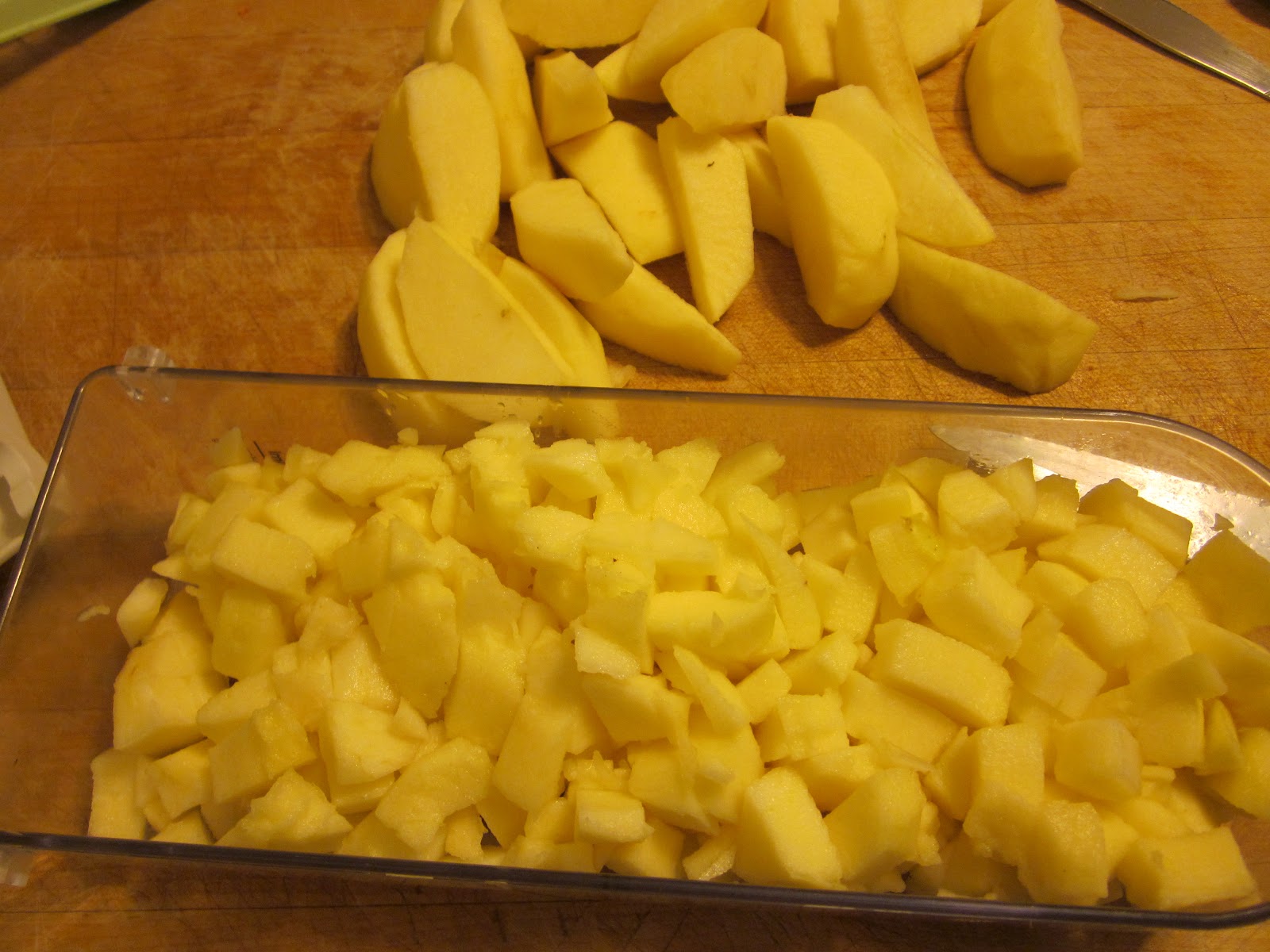

This is just a interior look at the diced apples for you. 


Place in pot (of course), & add a good sprinkling of cinnamon.
For 6 apples I use about 1/2 t. Also add about an 1/8 c of water. This will vary depending on the apples. Sometimes I just use a few tablespoons of water - sometimes, I'll use up to 1/2 c. 

The first time you make applesauce, you may want to go with 1/2 c water just to be sure. You can always strain off the excess, or uncover & let the extra evaporate. 
 Cover & cook at a slow simmer, about 20 minutes.


Of course you can leave the apples in larger chunks, but I like to use my smasher to break down the chunks even more. 
I do leave a variety of sizes though, just to make it a bit more appetizing & to give it a more home-cooked look. 

If you like, you can mush to a puree too, especially if you're serving a little one.

So, I hear you asking me, "What about sugar?" Well, I don't use any - I think the apples are plenty sweet for me. 

I remember once when I was making jam. At the beginning, I thought the jam was pretty tasty, but decided to add fructose for others. I seem to have just kept adding & adding & adding more fructose, not really knowing when enough was enough. Looking back I really believe less is more.

You can make applesauce with even one apple if you like - it's worth it even or especially if you're cooking for yourself! You're worth it!!!

A special side-note: Back in 2003 I attended the National Storytelling Festival in Jonesborough, Tennessee. I stayed at a small bed & breakfast. The owner was this very special older woman who would fix breakfast for us. Every morning, before we rose, I could smell the apple aroma in her kitchen. She would simply slice up apples, blanch them in water & serve, slightly softened - delicious & one memory that will stay with me forever! 

Peace & Holiday Warmth,

Marcy Hope Williams


Wednesday, July 18, 2012

What about Left-overs, A Mystery & Cotyledons?


Here's the left-over sunflower seed sprouts from last week that I failed to clip & harvest. Live & learn - I had no idea (until tonight) that if you let them go this long, the leaves become very bitter and has a very strong weedy taste to it. In fact the leaves have become fuzzy too. 

Now, I am sure this is all part of nature's plan to help protect the plant from predators; however, I was a bit disappointed to see so much waste - I was so looking forward to adding this ingredient to my salad - oh, alas! I'll leave a few in the pot & later transplant them so that they can grow into the full-fledged sunflowers they were destined to be. Then I could harvest the seeds!  


These are the sprouts that were too overgrown to eat, a whole towel full!

Later that night... mystery solved! 

My daughter Eden who has been working with plants for almost 5 years now enters the scene. I showed her the sprouts & she explained to me that when a plant grows, its first two leaves, which are part of the seed or embryo, are called the cotyledon leaves. The next leaves are usually different than the first two. 

So I took a second look at the sprout. She was right - the 1st two leaves were the sprouts that I was used to eating, but the other leaves on the plant had grown very different. So, guess what? I can still eat the cotyledon leaves off of these sprouts! I am sad though that I plucked so many out of the ground tonight instead of creating a field of sunflowers. 

Have you ever imagined if we were to actually plant all of the seeds that go through our hands, what a Garden of Eden the earth would be?  

I think these thoughts especially when I cut open a tomato. Every time I use a bell-pepper, acorn or pumpkin squash, I always remove the seeds, dry them out & store them - you never know when we'll need to use them!


I decided to cut & wash the rest of this red-cabbage head 
so it wouldn't go to waste - 
that way I can easily use it for a quick meal. 


Here's my basic salad tonight - plus, I'll bring a serving to work tomorrow. It looks refreshing - doesn't it? You can't see the yellow-crooked neck zucchini very well, but it's been cut up into bite-sized pieces. 

Turning the last corner before my house, my neighbor stopped me & gave me the yellow squash & a nice-sized zucchini. At first I looked at them & thought.. stir-fry!  But on second thought, I decided to make a nice fresh salad - more vitamins & minerals that way.  I'm sorry I didn't take a photo of the squashes before I began cutting, but believe me, the yellow squash was used tonight.

I consciously added many cruciferous vegetables to this salad to increase my chances of staying healthy. (Definition of cruciferous: a plant with long narrow seedpods, e.g. the cabbage, turnip, broccoli, or wallflower. Others - known as the "headless crucifers" include dark green leafy vegetables like kale & collard greens. Phytochemicals are found in cruciferous foods. 

This info was found on the American Institute for Cancer Research - you can easily google them on the web. 

Phytochemicals: The Cancer Fighters in the Foods We Eat

Phytochemicals are naturally occurring plant chemicals (phyto means plant in Greek). They
provide plants with color, odor and flavor.  Once we eat them, however, research shows they can influence the chemical processes inside our bodies in helpful ways.
Findings from laboratory studies have shown that phytochemicals have the potential to:
  • Stimulate the immune system
  • Block substances we eat, drink and breathe from becoming carcinogens
  • Reduce the kind of inflammation that makes cancer growth more likely
  • Prevent DNA damage and help with DNA repair
  • Reduce the kind of oxidative damage to cells that can spark cancer
  • Slow the growth rate of cancer cells
  • Trigger damaged cells to commit suicide before they can reproduce
  • Help to regulate hormones

                              
            **********************************************


Green olives added. 


I usually try to add some type of protein, so on went the raw sunflower seeds & vegan Garden burger Veggie Medley Veggie Burger (that's what they're called J.)

I'll leave you with this circular thought:

The healthier you get, the healthier you choose to eat.
and
The healthier you choose to eat, the healthier you get.

hmmm - sounds easy!